
Adsense Fill Rate Problems
Low AdSense fill rate can reduce your websites earnings by leaving valuable ad inventory unmonetized. Learn what causes poor fill rate, how it impacts CPM and RPM, and how premium demand sources can help maximize ad revenue.
AD-PERFORMANCE ISSUES
Jessica
5/12/20261 min read
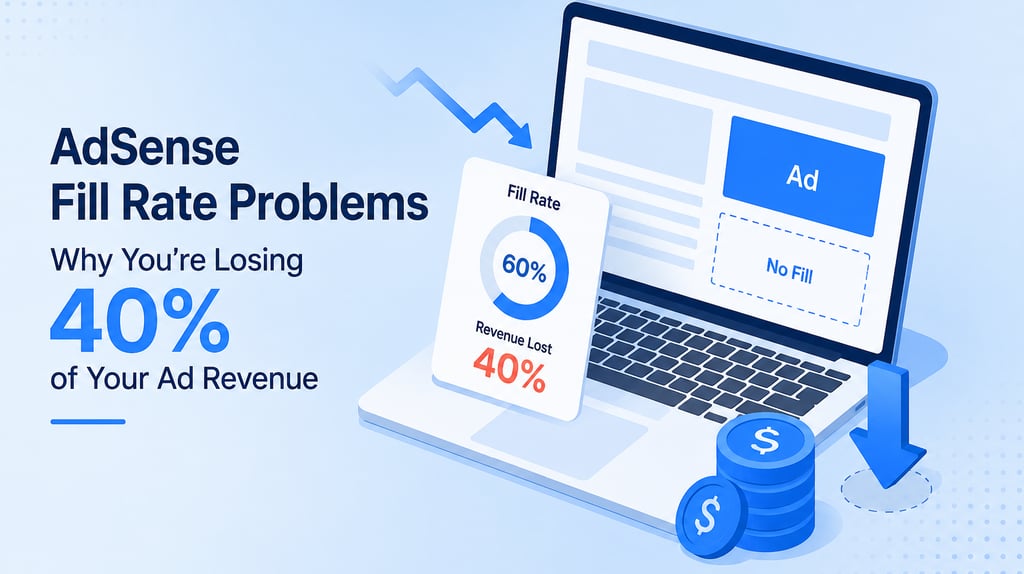
One of the most overlooked issues in website monetization is fill rate.
Many publishers assume that if a page loads an ad slot, it means it’s being fully monetized.
That is not always true.
1. What fill rate actually means
Fill rate refers to:
the percentage of ad requests that actually get filled with a paying ad, compared to those that do not get filled with an ad.
So if your fill rate is 40%, that means:
60% of impressions are going unmonetized or under-monetized
2. Why fill rate drops happen
Common reasons include:
limited advertiser demand
geo-targeting gaps
low competition for inventory
relying on a single ad provider
3. The hidden revenue leak
Even if your traffic is stable, low fill rate means:
empty ad slots
fallback ads (low CPM)
lost bidding competition
This silently reduces total revenue.
4. Why AdSense alone is not enough
AdSense does not always have enough demand to fill every impression at optimal prices.
So what happens is:
Ad request is sent
No high-paying bid wins
Low-value fallback fills it (or nothing shows)
Adsense is definitely great for very small publishers, but at scale, simply relying on Adsense alone can cause a revenue leakage.
5. How premium demand fixes fill rate
Advanced monetization setups introduce:
multiple demand sources
real-time bidding competition
header bidding layers
Optimized layouts
This increases:
fill rate
CPM
overall RPM
6. A better approach for publishers
Instead of relying on a single demand source, publishers are now moving toward multi-source monetization stacks that maximize competition for each impression.
Platforms like AdPlunge are built around this idea, where publishers get connected to premium demand sources such as AdX and major SSPs (e.g. OpenX) to help improve both fill rate and revenue efficiency.
Conclusion
Fill rate issues are often invisible, but they can quietly cost publishers a large portion of their revenue.
Fixing it usually requires increasing demand competition, not just increasing traffic.
© 2025. All rights reserved.