
How Header Bidding Works (Simple Guide for Publishers)
Learn how header bidding works and why it helps publishers increase CPMs and fill rates. A simple, step-by-step guide to understanding modern ad monetization with solutions like Adplunge.
Mellissa
2/11/20262 min read
What is header bidding?
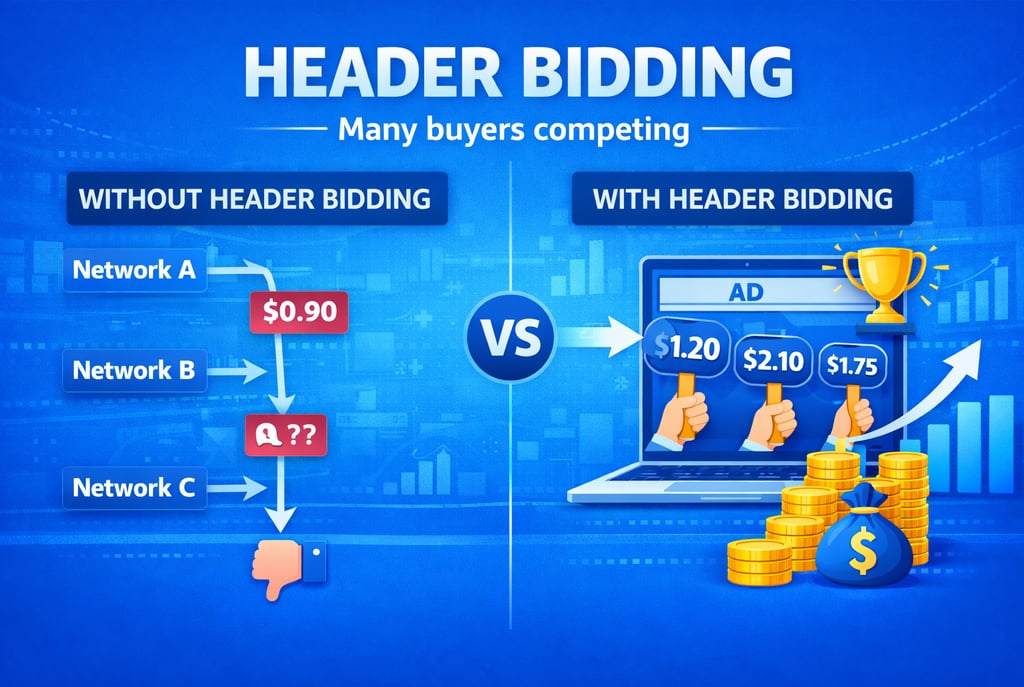
Header bidding is a programmatic advertising technique that allows multiple ad networks to compete for your ad space at the same time before the ad server makes its final decision.
Instead of selling an impression to just one network, header bidding creates an auction between several demand sources, which usually leads to higher CPMs and better fill rates.
In simple terms:
One network = one buyer
Header bidding = many buyers competing
More competition usually means more revenue.
How ads worked before header bidding
Before header bidding, most publishers used a system called waterfall or passback.
Here’s how it worked:
Ad network A gets the first chance.
If they don’t buy the impression, it passes to network B.
If B declines, it passes to network C.
The problem:
Buyers never competed at the same time.
Lower-paying networks sometimes won impressions.
Publishers lost money.
Header bidding solved this.
How header bidding works step by step
Here’s the simplified process.
Step 1: User visits your website
When someone opens your page, the ad slot is triggered.
Step 2: Multiple ad networks receive the bid request
Instead of one network, several demand partners are contacted at the same time.
These may include:
Ad exchanges
SSPs
Ad networks
Direct advertisers
Step 3: Each network places a bid
Each bidder responds with:
A CPM offer
A creative (ad)
Example:
Network A: $1.20 CPM
Network B: $2.10 CPM
Network C: $1.75 CPM
Step 4: The highest bid wins
The ad server compares all bids and serves the highest one.
In this example:
Network B wins with $2.10 CPM
Why header bidding increases revenue
Header bidding improves two key metrics:
1) CPM (cost per thousand impressions)
Because more buyers compete, prices rise.
2) Fill rate
If one network doesn’t bid, another might.
This reduces unsold impressions.
The result:
Higher overall earnings
More stable revenue
Types of header bidding
There are three main setups.
1) Client-side header bidding
Runs in the user’s browser
Uses JavaScript
Most common setup
Pros:
Easy to implement
Widely supported
Cons:
Can slow page load if poorly optimized
2) Server-side header bidding
Auction happens on a remote server
Not in the user’s browser
Pros:
Faster page load
Handles more bidders
Cons:
Slightly less transparency
3) Hybrid header bidding
Combines client-side and server-side
Used by advanced setups
This is what many modern monetization platforms use.
Common header bidding partners
Some typical demand sources include:
Google AdX
OpenX
Magnite
PubMatic
Index Exchange
Various SSPs and ad networks
The key is not just the number of bidders, but the quality of demand.
Does every site need header bidding?
Header bidding works best for sites that have:
At least 50,000 monthly visitors
Consistent traffic
Multiple ad placements
Smaller sites can still use it, but results vary depending on demand quality.
Common mistakes publishers make
Poor ad placement
Bad placements can:
Lower CPMs
Reduce engagement
Cause policy issues
No optimization
Header bidding is not “set and forget.”
It requires:
Bidder tuning
Floor price adjustments
Performance monitoring
A simpler alternative for publishers
Many publishers don’t want to manage:
Bidder integrations
Auction logic
Performance tuning
That’s where managed monetization solutions come in.
Platforms like Adplunge handle:
Multiple demand sources
Optimized header bidding setups
Fill rate improvements
Revenue tracking
This allows publishers to focus on content while the monetization runs in the background.
Final thoughts
Header bidding is one of the biggest improvements in programmatic advertising.
It increases competition, improves fill rates, and usually leads to higher CPMs.
But the setup can be complex, and results depend heavily on the quality of demand and optimization.
For many publishers, using a managed solution is the fastest way to benefit from header bidding without the technical overhead.
© 2025. All rights reserved.