
What Actually Determines CPM?
CPM is one of the most important metrics in digital advertising, yet many publishers don't fully understand what influences it. In this article, we break down the key factors that determine CPM, including audience value, user intent, geography, niche selection, advertiser competition, engagement, and ad viewability. Learn why some websites earn significantly higher CPMs than others and what publishers can do to increase the value of their inventory and maximize ad revenue.
GENERAL MONETIZATION
Jason
6/1/20263 min read
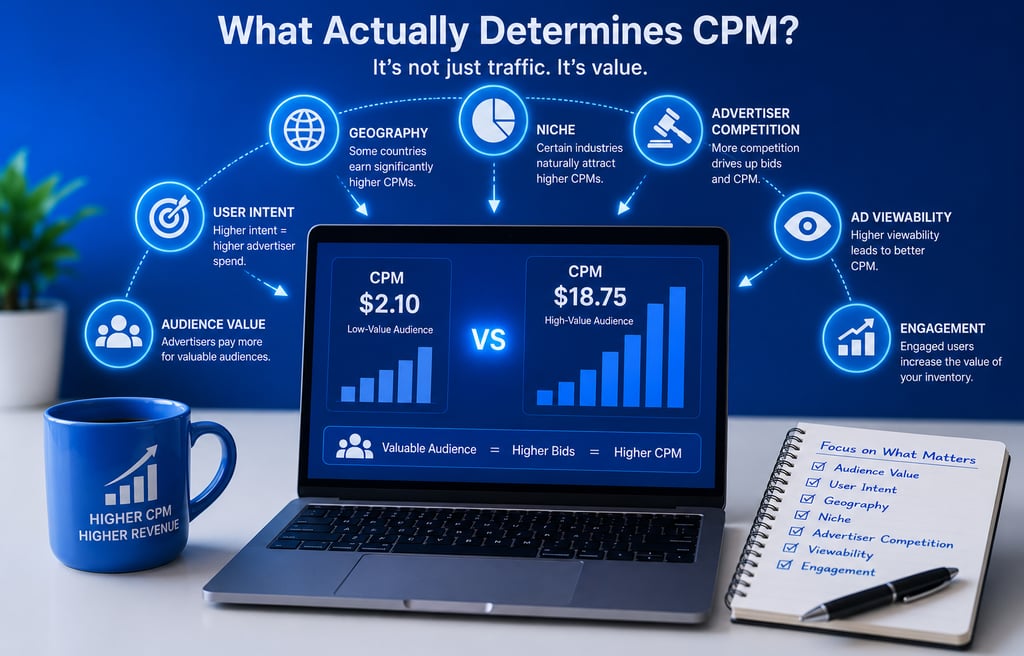
One of the most common questions publishers ask is:
"Why is my CPM so low?"
And usually, the first thing they look at is traffic.
More traffic should mean higher CPMs, right?
Not necessarily.
In fact, two websites with identical traffic can have completely different CPMs.
One might earn a $2 CPM.
Another might earn a $20 CPM.
So what actually determines CPM?
The answer is more complex than most publishers realize.
Because CPM is not determined by traffic volume alone.
It's determined by how much advertisers are willing to pay to reach your audience.
First, What Is CPM?
CPM stands for:
Cost Per Mille (Cost Per 1,000 Ad Impressions)
It measures how much advertisers pay for every 1,000 times an ad is displayed.
For publishers, CPM is one of the biggest factors influencing overall revenue.
Generally speaking:
Higher CPM = Higher Revenue
But understanding what influences CPM is where things get interesting.
The Biggest Factor: Audience Value
Advertisers do not buy traffic.
They buy audiences.
Every advertiser asks the same question:
"How valuable is this user to my business?"
For example:
A visitor researching:
mortgages
insurance
investment accounts
is often worth far more than someone browsing entertainment content.
This is why some niches naturally attract higher CPMs.
User Intent Plays a Massive Role
Imagine two users.
User A
Searches:
"Best mortgage lenders in 2026"
User B
Searches:
"Funny dog videos"
Both generate an ad impression.
But advertisers know User A is much closer to making a purchase.
As a result:
advertiser competition increases
bids rise
CPM increases
Intent is one of the strongest drivers of ad value.
Geography Can Change CPM Dramatically
A common mistake publishers make is assuming all traffic is equal.
It isn't.
Traffic from countries such as:
United States
Canada
United Kingdom
Australia
often earns significantly higher CPMs.
Why?
Because advertisers spend more money in these markets.
More advertiser competition means:
higher bids
stronger auctions
better CPMs
This is why a website with fewer US visitors can sometimes outperform a website with much larger global traffic.
Niche Selection Matters
Some industries naturally attract higher advertiser spending.
Examples include:
Higher CPM Niches
Finance
Insurance
SaaS
Business
Legal
Education
Lower CPM Niches
Entertainment
Memes
General gaming
Viral content
This does not mean lower-CPM niches cannot be profitable.
It simply means advertiser demand differs significantly.
Advertiser Competition Is Everything
Programmatic advertising works through auctions.
When multiple advertisers want the same audience:
bids increase
CPM rises
publishers earn more
When competition is weak:
bids fall
CPM declines
revenue suffers
This is why increasing advertiser competition is one of the most powerful monetization improvements a publisher can make.
Ad Viewability Affects CPM
Advertisers prefer ads that users actually see.
If your ads are:
below the fold
rarely viewed
quickly skipped
advertisers may bid less aggressively.
Higher viewability generally leads to:
stronger advertiser confidence
better bidding
improved CPMs
This is one reason layout optimization can significantly impact revenue.
Audience Engagement Influences Value
Publishers often overlook engagement metrics.
Things like:
session duration
pageviews per session
bounce rate
all influence how valuable your inventory appears.
Engaged users typically generate:
more impressions
stronger advertiser interest
better overall monetization performance
Why Publishers Often Focus on the Wrong Metric
Many publishers obsess over:
"How can I get more traffic?"
But sometimes the better question is:
"How can I increase the value of the traffic I already have?"
Because improving audience quality often increases CPM faster than increasing traffic volume.
A Common CPM Myth
Myth:
Higher traffic automatically means higher CPM.
Reality:
Traffic volume has very little direct impact on CPM.
A website with:
50,000 highly valuable visitors
can easily earn higher CPMs than a site with:
500,000 low-intent visitors
Audience quality almost always wins.
How Premium Demand Changes CPM
Even if your audience is valuable, revenue depends on advertiser competition.
Many publishers rely on basic monetization setups that limit access to premium demand.
As websites grow, increasing auction pressure becomes increasingly important.
This is why many publishers move beyond basic solutions and work with premium monetization partners such as AdPlunge to help maximize advertiser competition and improve CPM performance.
Because valuable traffic deserves valuable demand.
Final Thoughts
CPM is determined by much more than traffic volume.
Factors such as:
audience value
user intent
geography
niche
advertiser competition
ad viewability
engagement
all play important roles.
Understanding these factors helps publishers focus on what truly drives revenue instead of chasing vanity metrics.
At the end of the day, advertisers pay for valuable audiences.
And the more valuable your audience is, the more valuable your inventory becomes.
Related Articles
Why Advertisers Pay More for Certain Audiences
Why Some Niches Earn Higher CPMs
Why Finance Websites Earn Higher RPM
Why US Traffic Earns More Than Other Countries
© 2025. All rights reserved.