
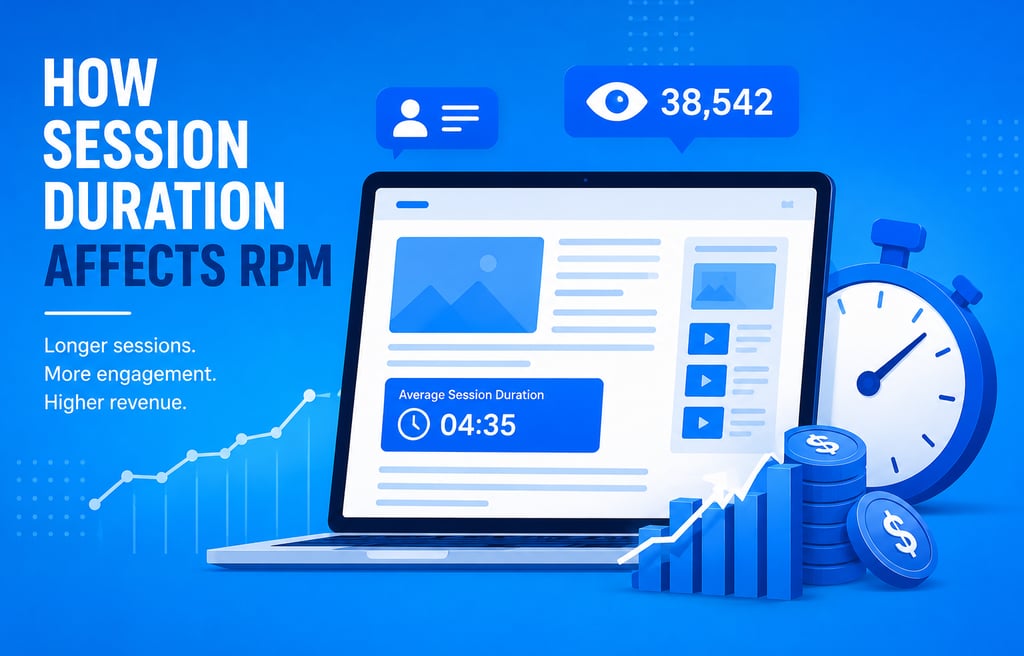
How Session Duration Affects RPM
Session duration plays a major role in how much revenue a website generates, yet many publishers overlook it when analyzing performance. In this article, we explain how the amount of time users spend on your site impacts RPM, ad impressions, and overall monetization efficiency. Learn why longer sessions lead to higher revenue, what causes users to leave quickly, and how improving engagement can significantly increase your ad earnings without increasing traffic.
MONETIZATION STRATEGIES
Veronica
5/31/20263 min read
You can have all the traffic in the world.
But if users leave too quickly, your revenue often suffers.
This is something many publishers only realize after checking their analytics:
High traffic doesn’t always mean high earnings.
A website with 100,000 visitors and strong engagement can earn significantly more than a site with 300,000 visitors who leave almost immediately.
One of the biggest hidden factors behind this is session duration.
Let’s break down why how long users stay on your site has such a direct impact on RPM—and what it means for your ad revenue.
You’re Getting Traffic… But Users Aren’t Staying
A common scenario looks like this:
Traffic is growing
SEO is working
Pageviews are increasing
But revenue barely moves.
When you look closer, you notice:
Most users leave within a few seconds.
They don’t scroll.
They don’t click.
They don’t see many ads.
And that’s where the problem starts.
What Session Duration Actually Means
Session duration refers to:
How long a user stays on your website during a single visit.
It’s one of the strongest indicators of engagement.
A longer session usually means:
more pageviews
more ad impressions
higher engagement
better monetization opportunity
A short session usually means the opposite.
Why Advertisers Care About Time on Site
Advertisers don’t just pay for traffic.
They pay for attention.
If a user stays on your site longer:
ads have more time to load
ads are seen more often
users are more likely to scroll and engage
viewability increases
This makes your inventory more valuable.
When advertisers see higher engagement signals, they are often willing to bid more aggressively.
The Direct Link Between Session Duration and RPM
Here’s the simple chain:
Longer session duration → More pages viewed → More ads shown → More impressions → Higher revenue per visitor → Higher RPM
Now compare that to a short session:
Short session duration → 1 page view → Few ads seen → Low impressions → Low RPM
Even if both websites have the same traffic, their revenue can be completely different.
Example: Two Websites, Same Traffic
Imagine two websites both getting 100,000 monthly visitors.
Website A
Average session: 4 minutes
Users view 3–5 pages
Strong internal linking
High engagement
Result:
Higher RPM and significantly better revenue
Website B
Average session: 20 seconds
Users view 1 page and leave
Weak engagement
Result:
Low RPM, even with the same traffic
Why Short Sessions Kill Monetization Efficiency
When users leave quickly:
fewer ads load
fewer impressions are generated
viewability drops
revenue per user decreases
Even if your CPM looks fine, you simply don’t have enough impressions per visitor to maximize earnings.
What Causes Low Session Duration
Most publishers don’t realize their content structure is the issue.
Common causes include:
1. Weak internal linking
Users have nowhere to go next.
2. Slow introductions
Users don’t find value quickly.
3. Misleading traffic sources
Users arrive expecting something else.
4. Poor content structure
Hard to read, hard to navigate, or too shallow.
5. No “next step” content
Users finish one article and leave.
How to Increase Session Duration (And RPM)
Improving session duration is one of the highest leverage monetization improvements you can make.
1. Add strong internal linking
Guide users to related articles naturally.
2. Improve content depth
Longer, more useful content keeps users engaged.
3. Add “next article” sections
Don’t let the journey end on one page.
4. Improve readability
Short paragraphs and structured sections keep users scrolling.
5. Match intent properly
Make sure users get exactly what they expected.
Why This Matters More Than More Traffic
A lot of publishers focus on:
getting more visitors
chasing viral traffic
increasing impressions
But:
improving engagement often increases revenue faster than increasing traffic.
Because you’re extracting more value from each visitor.
The Monetization Reality Most Publishers Miss
Two publishers can have identical traffic, but:
one earns 3x–10x more
The difference is often not CPM alone.
It’s:
session duration
engagement
page depth
user experience
These signals tell advertisers how valuable your audience really is.
Where AdPlunge Fits In
Once you improve engagement, the next step is maximizing the value of every impression.
This is where many publishers start looking beyond basic monetization setups.
Platforms like AdPlunge help publishers:
increase advertiser competition
access premium demand sources
improve RPM efficiency across sessions
maximize revenue from engaged users
Because longer sessions only matter if your demand setup can properly monetize them.
Final Thoughts
Session duration is one of the most underrated factors in website monetization.
It directly impacts:
impressions per user
engagement levels
ad viewability
overall RPM
If users don’t stay, nothing else in monetization fully works.
But when users do stay, even modest traffic can become highly valuable.
In many cases, improving engagement is the fastest path to increasing revenue without needing more visitors.
Related Articles
Why Your Website Traffic Increased But Revenue Didn’t
© 2025. All rights reserved.