
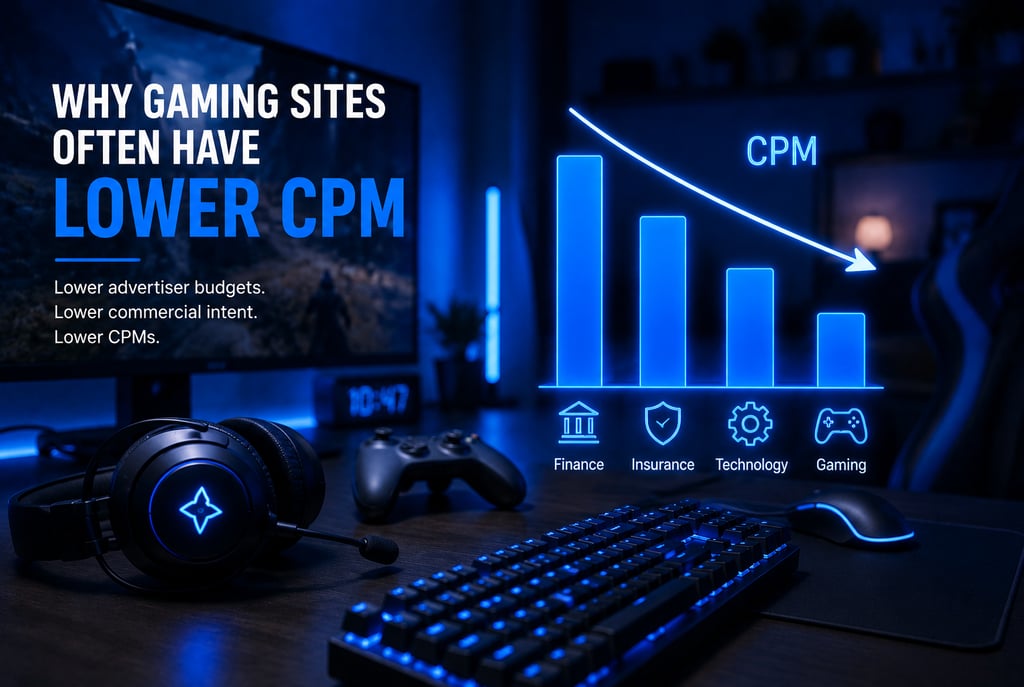
Why Gaming Sites Often Have Lower CPM
Gaming websites often generate large amounts of traffic but frequently earn lower CPMs than finance, business, and other high-value niches. In this article, we explain why gaming traffic typically attracts lower advertiser bids, how audience intent and customer value influence CPMs, and what gaming publishers can do to increase ad revenue. Learn the key factors affecting gaming monetization and discover strategies to maximize earnings from your existing audience.
MONETIZATION STRATEGIES
Matt
5/30/20264 min read
You've done everything right.
Your gaming website is growing.
Traffic is increasing every month.
Players are spending time on your content.
Pageviews look great.
But when you check your ad revenue, something feels off.
You start comparing your RPMs and CPMs with publishers in other industries and notice something frustrating:
Finance websites are earning 5x, 10x, or even 20x more per visitor.
So what gives?
Why can a gaming website with hundreds of thousands of monthly visitors sometimes earn less than a much smaller finance or business website?
The answer isn't that gaming traffic is bad.
It's that advertisers value different audiences differently.
Let's break down exactly why gaming sites often earn lower CPMs and what publishers can do about it.
First, Lower CPM Doesn't Mean Lower Revenue
Before we go any further, it's important to understand something:
Low CPM does not automatically mean a website is unsuccessful.
Many gaming websites generate enormous traffic volumes.
A gaming site with:
1 million monthly pageviews
a $3 CPM
can still earn significantly more than a smaller niche site with:
50,000 pageviews
a $20 CPM
The challenge is that gaming publishers often need more traffic to generate the same revenue as publishers in certain high-value niches.
Advertisers Pay Based on Customer Value
Imagine you're an insurance company.
A single customer might be worth:
hundreds of dollars
thousands of dollars
or even more
Now imagine you're advertising a mobile game.
A user might spend:
nothing
a few dollars
occasionally much more
The average customer value is often dramatically lower.
Because of this, advertisers simply cannot justify paying the same advertising rates.
This is one of the biggest reasons gaming CPMs tend to be lower.
Gaming Audiences Often Have Lower Commercial Intent
Let's compare two searches.
Person A searches:
"Best mortgage rates for first-time home buyers"
Person B searches:
"Best weapons in Call of Duty"
Which user is more likely to make a major financial decision?
The answer is obvious.
The mortgage visitor may be worth thousands of dollars to advertisers.
The gaming visitor may not be planning to purchase anything at all.
This difference in commercial intent directly impacts advertiser bidding behavior.
Many Gaming Advertisers Have Smaller Budgets
Gaming publishers often attract advertisers such as:
Mobile games
Hardware brands
Gaming accessories
Energy drinks
Entertainment products
While these industries can spend heavily, many still cannot compete with the budgets available in:
Finance
Insurance
Legal services
SaaS
Business software
As a result, advertiser competition is often lower.
And lower competition usually means lower CPMs.
Gaming Traffic Is Extremely Abundant
Another factor is supply.
There are millions of gaming-related websites, videos, communities, forums, and content creators online.
Because there is so much gaming inventory available:
advertisers have plenty of options
impressions are less scarce
bidding pressure is often lower
This abundance of inventory can reduce average CPMs across the sector.
Younger Audiences Can Affect Advertiser Demand
Many gaming audiences skew younger than audiences in finance, business, or professional niches.
While younger audiences are valuable in many ways, advertisers may sometimes view them as having:
lower purchasing power
fewer financial commitments
less immediate buying intent
This can impact advertiser bidding behavior.
Of course, this varies significantly depending on the game, platform, and audience demographics.
Not All Gaming Niches Are Equal
This is where many publishers get surprised.
Some gaming content earns significantly more than others.
For example:
Lower-Value Gaming Traffic
General gaming news
Meme content
Casual gaming discussions
Walkthroughs for older games
Higher-Value Gaming Traffic
Gaming hardware reviews
PC building guides
Console comparisons
Gaming laptops
Monitors and accessories
Software reviews
Why?
Because users are closer to making purchasing decisions.
Advertisers love audiences that are actively shopping.
A Common Mistake Gaming Publishers Make
Many gaming publishers focus entirely on increasing traffic.
Traffic growth is important.
But often the bigger opportunity lies in increasing the value of existing traffic.
For example:
Instead of publishing only gaming news, you might also create content around:
Gaming laptops
Graphics cards
Streaming equipment
Gaming chairs
Performance optimization tools
These topics often attract stronger advertiser demand because users are researching products and purchases.
How Gaming Publishers Can Increase Revenue
Even if CPMs are naturally lower, there are still several ways to improve monetization.
Improve Traffic Quality
Focus on attracting users with stronger purchasing intent.
Add Product-Focused Content
Hardware and accessory content often attracts premium advertisers.
Improve Ad Viewability
Better ad placements can significantly improve inventory value.
Increase Tier 1 Traffic
Traffic from countries like:
United States
Canada
United Kingdom
Australia
typically generates stronger advertiser demand.
Increase Advertiser Competition
One of the biggest revenue improvements often comes from increasing demand competition for your inventory.
Why Monetization Setup Matters More Than Most Publishers Realize
Many gaming publishers focus entirely on traffic generation.
But once traffic reaches scale, monetization becomes equally important.
Larger publishers often improve revenue through:
Header bidding
Multiple SSPs
Premium demand partnerships
Yield optimization
These strategies help increase competition for impressions and maximize inventory value.
This is why many growing publishers eventually move beyond basic monetization setups and work with premium monetization partners such as AdPlunge to help maximize RPM and improve overall revenue performance.
The Bigger Picture
Gaming websites don't earn lower CPMs because advertisers dislike gaming audiences.
They earn lower CPMs because:
customer values are often lower
buying intent is weaker
advertiser budgets are smaller
inventory supply is massive
However, gaming remains one of the largest content categories on the internet.
And with the right traffic, content strategy, and monetization setup, gaming publishers can still build highly profitable businesses.
Final Thoughts
If your gaming website has a lower CPM than websites in finance or business, that's completely normal.
Different niches attract different levels of advertiser demand.
What matters isn't comparing your CPM to other industries.
What matters is maximizing the value of your own audience.
The publishers who focus on traffic quality, advertiser competition, and monetization optimization are usually the ones that generate the strongest long-term revenue growth.
Related Articles
Why Finance Websites Earn Higher RPM
Why Some Niches Earn Higher CPMs
© 2025. All rights reserved.