
How Bounce Rate Impacts Ad Revenue
High bounce rate is one of the most overlooked reasons why websites struggle to generate strong ad revenue, even when traffic is growing. In this article, we explain how bounce rate affects RPM, impressions, and overall monetization performance. Learn why users leaving after a single page view reduces earnings, what causes high bounce rates, and how improving engagement can significantly increase ad revenue without increasing traffic.
MONETIZATION STRATEGIES
Matt
5/31/20263 min read
You can have solid traffic numbers.
You can even have growing SEO performance.
But when you check your revenue, something feels wrong:
“Why am I not earning more from this traffic?”
Then you look at your analytics and see it:
A high bounce rate.
This is one of the most misunderstood metrics in publishing, yet it has a direct impact on how much money your website makes.
Let’s break down what bounce rate actually means, why it matters for RPM, and what it tells advertisers about your audience.
First, What Is Bounce Rate?
Bounce rate refers to:
The percentage of users who leave your website after viewing only one page.
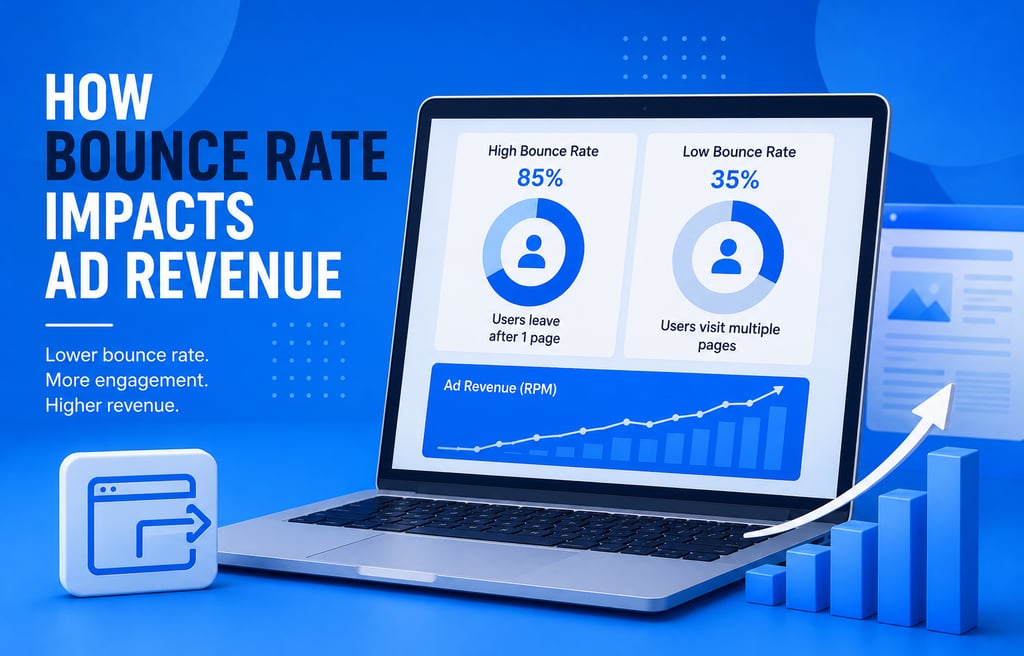
So if 100 users land on your site and 70 leave immediately without clicking anything else, your bounce rate is 70%.
High bounce rate usually means:
users are not engaging
users are not exploring further
users are not seeing more ads
And that last point is where revenue gets affected.
The Problem: High Traffic, Low Engagement
Many publishers focus only on traffic growth.
But here’s what often happens:
Traffic increases
SEO starts working
More users land on pages
But instead of exploring the site, users:
read one article
scroll briefly
leave immediately
So even though traffic is strong, engagement is weak.
And weak engagement leads to weak monetization.
Why Bounce Rate Affects RPM Directly
RPM is heavily influenced by how many ads a user sees per session.
If a user bounces quickly:
they only see 1 page
they only load a few ads
impressions are limited
Now compare that to a user who:
visits 3–5 pages
spends more time on site
sees multiple ad loads
That second user generates significantly more revenue.
So even with identical traffic, RPM can be completely different depending on bounce rate.
Advertisers Notice Engagement Signals
Advertisers don’t just look at impressions.
They also look at:
engagement quality
session depth
user behavior signals
A site where users consistently bounce quickly may be seen as lower quality inventory.
That can lead to:
lower bidding competition
weaker CPMs
reduced demand from premium advertisers
So bounce rate doesn’t just affect impressions, it can influence perceived inventory value.
Example: Two Websites, Same Traffic
Let’s compare two publishers:
Website A
Bounce rate: 80%
Users view 1 page
Low session depth
Result:
Lower RPM due to limited impressions per user
Website B
Bounce rate: 40%
Users view multiple pages
Strong internal linking
Result:
Higher RPM even with the same traffic
The difference is engagement, not traffic.
What Causes High Bounce Rate
High bounce rate usually isn’t random.
It’s caused by specific issues such as:
1. Weak content match
Users don’t find what they expected.
2. Poor introduction
Value is not delivered quickly.
3. No internal linking
Users have no clear next step.
4. Slow website experience
Users leave before content loads properly.
5. Low content depth
Nothing encourages users to stay.
How Bounce Rate Impacts Ad Impressions
This is the key monetization link:
Higher bounce rate → Fewer pages viewed → Fewer ads loaded → Lower impressions per session → Lower RPM
Even if CPM stays the same, total revenue drops because there are fewer monetizable opportunities per user.
How to Reduce Bounce Rate (And Increase Revenue)
Improving bounce rate is one of the fastest ways to improve RPM without increasing traffic.
1. Match search intent properly
Make sure users get exactly what they searched for.
2. Improve internal linking
Guide users to related articles naturally.
3. Add “next article” sections
Don’t let users exit after one page.
4. Improve content structure
Short paragraphs and clear formatting improve readability.
5. Increase content relevance
Better targeting reduces early exits.
Why Bounce Rate Alone Isn’t Everything
It’s important to understand:
Not all bounce rate is bad.
Some pages naturally answer questions quickly.
But from a monetization perspective, publishers should aim to:
increase meaningful engagement
encourage multi-page sessions
improve content discovery
Because more engagement means more ad opportunities.
Where This Fits in Monetization Strategy
Bounce rate is not just an SEO metric.
It is a monetization signal.
It affects:
session duration
pageviews per user
ad impressions
RPM
This is why improving engagement often leads to higher revenue even without increasing traffic.
How AdPlunge Fits In
Once engagement improves, the next step is maximizing the value of those engaged sessions.
Many publishers eventually realize that traffic quality alone is not enough, they also need stronger monetization infrastructure.
Platforms like AdPlunge help publishers:
increase advertiser competition
access premium demand sources
improve RPM efficiency across engaged users
maximize revenue from every session
Because better engagement only works fully when monetization systems are optimized to capture its value.
Final Thoughts
Bounce rate is one of the clearest signals of whether your traffic is being fully monetized.
High bounce rate means:
fewer pageviews per user
fewer ad impressions
lower revenue efficiency
But improving bounce rate can unlock significantly higher RPM without needing more traffic.
For many publishers, this is one of the fastest paths to increasing revenue.
Related Articles
How Session Duration Affects RPM
© 2025. All rights reserved.