
Why Your Website Traffic Increased but Revenue Didn't
If your website traffic has increased but your ad revenue hasn’t, you’re not alone. Many publishers assume more visitors automatically mean more earnings, but factors like traffic quality, fill rate, advertiser demand, engagement, and monetization setup all play a major role. In this guide, we break down why revenue can stagnate despite traffic growth, and what publishers can do to improve RPM and overall monetization performance.
AD-PERFORMANCE ISSUES
Matt
5/16/20262 min read
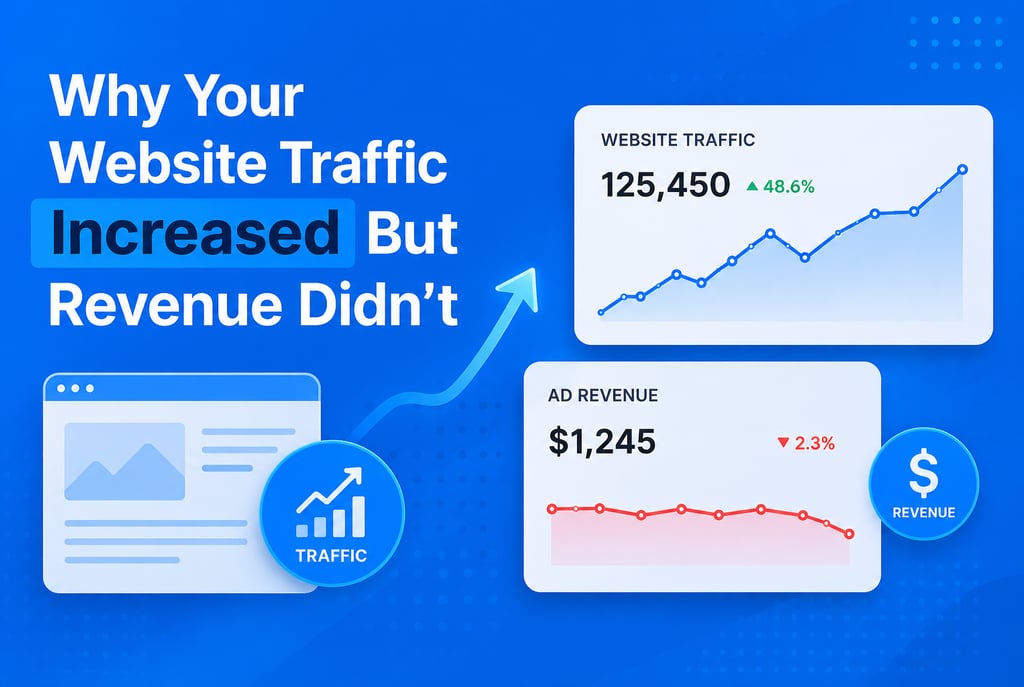
If your website traffic recently increased but your ad revenue barely moved or even dropped, you’re not alone.
This is one of the most frustrating monetization problems publishers face. On paper, more traffic should mean more revenue. But in reality, website monetization is far more complicated than simply getting additional visitors.
In many cases, the issue is not traffic volume at all. It’s how that traffic is being monetized.
More Traffic Does Not Always Mean More Revenue
A common misconception among publishers is:
“If I double my traffic, I should double my earnings.”
Unfortunately, that’s rarely how programmatic advertising works.
Ad revenue depends on several factors beyond pageviews, including:
visitor geography
advertiser demand
session duration
page engagement
device type
viewability
ad placement quality
demand competition
If your traffic increase comes from lower-value sources, revenue may barely improve even if your pageviews surge.
Traffic Quality Matters More Than Traffic Volume
Not all visitors are monetized equally.
For example:
traffic from the United States, Canada, and the United Kingdom often generates significantly higher CPMs
traffic from lower advertiser-demand regions generally monetizes at lower rates
engaged users typically generate more ad impressions and stronger advertiser bids
This means:
10,000 highly engaged visitors from high-value regions can outperform 100,000 low-quality visits in terms of ad revenue.
Your New Traffic May Be Less Valuable
Many publishers experience revenue stagnation after:
viral social traffic spikes
low-quality referral traffic
short-session mobile traffic
traffic from countries with weaker advertiser demand
These users often:
bounce quickly
view fewer pages
generate lower viewability
attract weaker advertiser competition
As a result, RPM can decline even while traffic grows.
Low Fill Rate Can Quietly Reduce Revenue
Another common issue is fill rate.
If advertiser demand cannot properly fill your available inventory, additional traffic does not fully translate into monetized impressions.
This leads to:
empty ad slots
low-paying fallback ads
reduced competition for impressions
Many publishers only discover this after investigating why earnings failed to scale alongside traffic. If you want to learn more about fill rates and the solutions to fixing them, then be sure to check out our guide on it here.
AdSense Alone Often Has Limitations
For smaller publishers, AdSense can be a strong starting point.
However, as websites grow, many publishers begin encountering monetization ceilings caused by:
limited demand competition
weaker bidding pressure
incomplete inventory optimization
This is one reason larger publishers frequently move toward:
premium demand sources
header bidding
multiple SSP integrations
yield optimization strategies
The goal is to increase competition for every impression rather than relying on a single monetization source.
Why Engagement Matters So Much
Advertisers care deeply about user engagement.
Metrics such as:
time on site
scroll depth
session duration
pageviews per visit
can significantly influence monetization performance.
A website with highly engaged users often receives:
stronger advertiser bids
better fill rates
improved RPM
Even moderate engagement improvements can noticeably increase overall revenue efficiency.
What Advanced Publishers Do Differently
Experienced publishers typically focus on:
improving demand quality
increasing viewability
optimizing ad placements
maximizing inventory competition
Instead of simply chasing more traffic, they optimize how existing traffic is monetized.
This is where premium monetization setups can make a major difference.
Platforms like AdPlunge help publishers connect inventory to premium demand sources, header bidding competition, and advanced monetization strategies designed to improve RPM and fill rate performance as websites scale.
Final Thoughts
If your traffic increased but revenue didn’t, the problem is usually not the traffic itself.
In many cases, the issue comes down to:
traffic quality
monetization efficiency
advertiser demand competition
fill rate optimization
Growing traffic is important, but maximizing the value of each visitor is what truly drives sustainable publisher revenue.
© 2025. All rights reserved.