
How Pageviews Per Session Increase Revenue
Pageviews per session is one of the most important but overlooked factors influencing website revenue. In this article, we explain how increasing the number of pages a user views directly boosts ad impressions, improves engagement, and significantly raises RPM without needing additional traffic. Learn why session depth matters, what causes users to leave early, and how publishers can structure their content to keep visitors engaged longer and increase monetization performance.
MONETIZATION STRATEGIES
Jason
5/31/20263 min read

You can have strong traffic numbers.
You can even have a growing audience.
But when you check your revenue, something doesn’t add up:
“Why am I not earning more from the traffic I already have?”
This is one of the most common frustrations among publishers.
And in many cases, the answer isn’t more traffic.
It’s more pageviews per session.
Because the difference between a low-earning website and a high-earning one is often not how many users arrive — but how many pages each user actually sees.
What Are Pageviews Per Session?
Pageviews per session refers to:
The average number of pages a user views before leaving your website.
For example:
1.2 pages per session = users mostly leave after one page
3.5 pages per session = users actively browse multiple pages
This metric directly reflects how engaged your audience is.
And engagement is one of the strongest drivers of ad revenue.
Why This Metric Matters So Much for Revenue
Here’s the simple reality most publishers miss:
Every additional pageview = another opportunity to show ads.
So when users only view one page:
you only get 1 set of impressions
revenue per visitor is capped
But when users view multiple pages:
impressions multiply
revenue per visitor increases significantly
RPM improves without any new traffic
This is why two websites with the same traffic can earn completely different revenue.
Example: Same Traffic, Different Outcomes
Imagine two websites both getting 100,000 monthly visitors.
Website A
1.2 pageviews per session
Most users leave after one article
Limited ad exposure
Result:
Low revenue per visitor
Website B
4.0 pageviews per session
Users explore multiple articles
Strong internal linking
Result:
3–4x higher revenue without increasing traffic
This is the power of session depth.
Why Publishers Underestimate Pageviews Per Session
Many publishers focus heavily on:
SEO rankings
traffic growth
keyword targeting
But they ignore what happens after the click.
They assume:
“If users land on my site, the job is done.”
In reality, the real monetization opportunity begins after the first page loads.
Because the more pages a user views, the more valuable that session becomes.
What Causes Low Pageviews Per Session
If users only view one page, it’s usually due to structural issues, not traffic quality.
Common causes include:
1. No internal linking strategy
Users have no clear next step.
2. Weak content clustering
Articles exist in isolation.
3. Lack of “related content” flow
Users finish reading and exit immediately.
4. Content mismatch
Users don’t find what they expected and leave.
5. Poor navigation design
Users don’t know where to go next.
How More Pageviews Directly Increase RPM
Pageviews per session affect RPM in a very direct way:
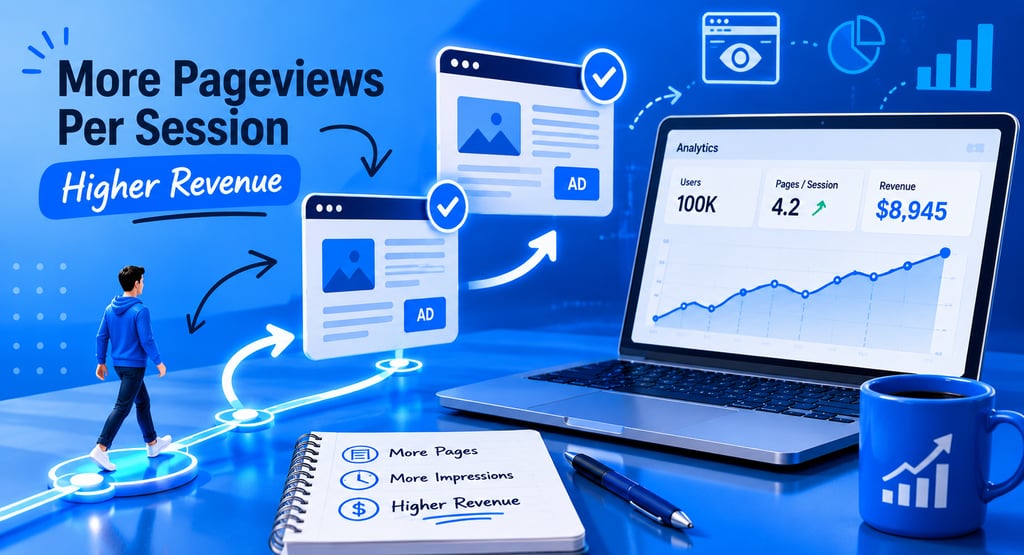
More pages per session → More ad impressions per user → Higher total revenue per visitor → Higher RPM
Even if CPM stays the same, revenue increases simply because you are monetizing more attention per user.
How to Increase Pageviews Per Session
Improving this metric is one of the highest-leverage optimizations a publisher can make.
1. Build strong internal linking
Guide users to related content naturally within articles.
2. Create topic clusters
Instead of isolated posts, build connected content groups.
3. Add “next article” sections
Always give users a clear continuation path.
4. Improve content depth
Shallow content reduces exploration. Depth increases engagement.
5. Improve homepage and category structure
Make discovery easy and intuitive.
The Bigger Monetization Insight
Most publishers focus on getting users in.
But the real revenue difference comes from:
how long you can keep users inside your ecosystem.
Because every additional page viewed:
increases ad impressions
improves engagement signals
raises revenue per session
This is why high-performing publishers don’t just optimize for clicks, they optimize for session flow.
Where This Fits in Your Monetization Strategy
Pageviews per session sits at the center of:
engagement
session duration
bounce rate
RPM
Improving it often leads to revenue growth without any additional traffic acquisition costs.
How AdPlunge Fits In
Once you increase pageviews per session, you’re no longer just optimizing traffic, you’re maximizing inventory value.
But that value still depends on demand competition.
This is where many publishers eventually upgrade beyond basic monetization setups and work with premium demand partners such as AdPlunge to help maximize RPM across highly engaged sessions.
Because more pageviews only matter if each impression is properly monetized.
Final Thoughts
Pageviews per session is one of the most powerful but overlooked revenue drivers in publishing.
It determines:
how many ads users see
how much value each visitor generates
how efficiently your traffic converts into revenue
Improving it often leads to immediate RPM gains without needing more traffic.
In many cases, it’s the difference between a low-performing site and a highly profitable one.
Related Articles
How Session Duration Affects RPM
How Bounce Rate Impacts Ad Revenue
© 2025. All rights reserved.