
How Ad Viewability Affects Revenue
Ad viewability is one of the most important factors influencing ad revenue, yet many publishers overlook its impact on CPM and RPM. In this article, we explain what ad viewability is, why advertisers care about it, and how it affects the value of your inventory. Learn how engagement, page layout, page speed, and user behavior influence viewability, and discover practical ways to increase the number of ads users actually see to maximize revenue from your existing traffic.
GENERAL MONETIZATION
Matt
6/1/20263 min read
Imagine you own a billboard.
Thousands of cars drive past it every day.
But there's one problem:
The billboard is hidden behind a building.
Technically, the ad exists.
But almost nobody sees it.
Now ask yourself:
How much would advertisers pay for that billboard?
Probably not much.
The same principle applies to website advertising.
Just because an ad loads doesn't mean it delivers value.
Advertisers want ads that users actually see.
And that's where ad viewability comes in.
For many publishers, improving viewability is one of the fastest ways to increase RPM without adding a single new visitor.
What Is Ad Viewability?
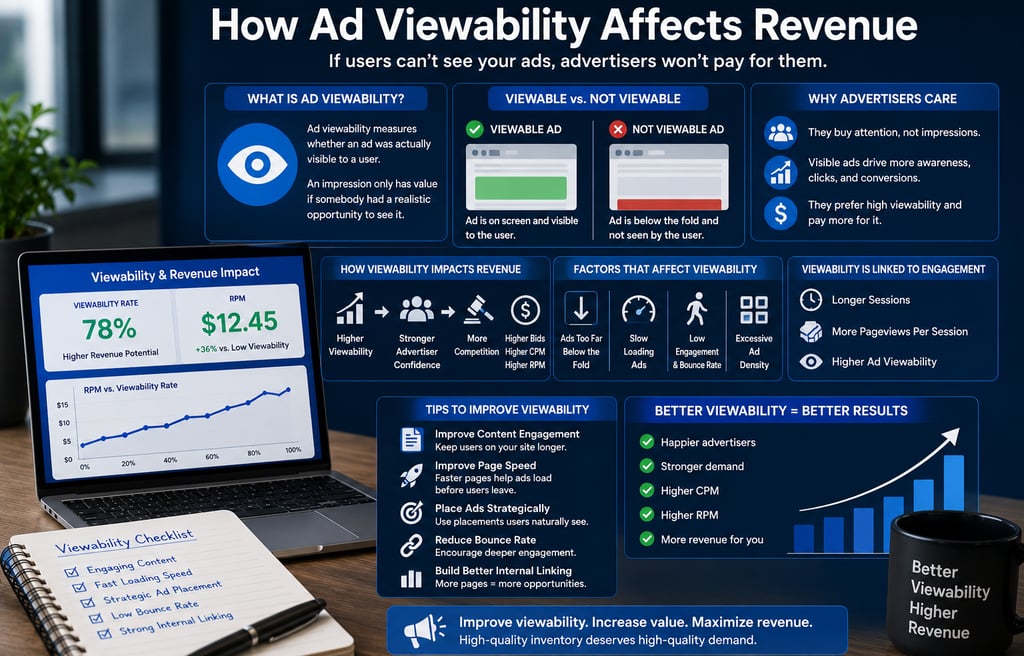
Ad viewability measures whether an ad was actually visible to a user.
In simple terms:
An ad impression only has value if somebody had a realistic opportunity to see it.
If an ad loads far below the fold and a visitor leaves before reaching it, advertisers receive very little value from that impression.
This is why viewability has become one of the most important metrics in modern advertising.
Why Advertisers Care So Much About Viewability
Think about it from an advertiser's perspective.
Their goal isn't to buy impressions.
Their goal is to buy attention.
An ad that loads but is never seen has little chance of:
generating awareness
driving clicks
producing conversions
As a result, advertisers prefer inventory with strong viewability rates.
And they're often willing to pay more for it.
How Viewability Impacts CPM
Programmatic advertising runs on auctions.
When advertisers believe inventory performs well, they bid more aggressively.
Higher viewability often leads to:
stronger advertiser confidence
increased competition
higher bids
improved CPMs
The reverse is also true.
Poor viewability can reduce demand and suppress CPM performance.
How Viewability Impacts RPM
This is where publishers feel the real effect.
Better viewability often means:
stronger CPMs
more valuable impressions
higher overall revenue
Which ultimately leads to improved RPM.
In many cases, two websites with identical traffic can have very different RPMs simply because one has significantly better viewability.
Common Reasons for Poor Viewability
Many publishers accidentally hurt viewability without realizing it.
Ads Too Far Below the Fold
If users never scroll far enough, those ads are unlikely to be viewed.
Slow Loading Ads
If users leave before ads appear, viewability suffers.
Poor Content Engagement
Visitors who leave quickly often don't reach lower ad placements.
Excessive Ad Density
Adding too many ads can actually reduce the value of each individual placement.
More ads doesn't always mean more revenue.
The Relationship Between Engagement and Viewability
Viewability doesn't exist in isolation.
It is heavily connected to:
session duration
pageviews per session
bounce rate
The longer users stay:
the more content they consume
the more ads they see
the higher viewability becomes
This is why engagement improvements often produce monetization improvements.
Why Traffic Alone Doesn't Solve Viewability Problems
A common mistake publishers make is thinking:
"If I double traffic, revenue will double."
But if viewability remains poor, a large portion of those impressions may still be undervalued.
Sometimes improving viewability produces larger revenue gains than increasing traffic.
Signs You May Have a Viewability Problem
You might have a viewability issue if:
traffic is increasing but RPM remains stagnant
CPMs seem lower than industry averages
users leave quickly
most pageviews occur on a single page
ad performance varies dramatically between placements
These are often indicators that users simply aren't seeing enough of your inventory.
How to Improve Ad Viewability
1. Improve Content Engagement
The longer users stay, the more ads become visible.
2. Improve Page Speed
Faster loading pages improve the chances that ads render before users leave.
3. Place Ads Strategically
Focus on placements users naturally encounter while consuming content.
4. Reduce Bounce Rate
Encourage visitors to engage with multiple pages and spend more time on site.
5. Build Better Internal Linking
More pageviews often create more opportunities for highly viewable impressions.
Why Premium Demand Values Viewability
As publishers grow, viewability becomes increasingly important.
Many premium advertisers actively prefer inventory with strong engagement and visibility metrics.
This means publishers with high-viewability inventory often attract:
better advertiser competition
stronger bids
improved monetization outcomes
How AdPlunge Helps Publishers Maximize Viewability Value
Improving viewability is only half the equation.
You also need demand sources that recognize and reward that quality.
Platforms like AdPlunge help publishers:
increase advertiser competition
access premium demand
maximize revenue from high-quality inventory
improve RPM performance across engaged audiences
Because highly viewable inventory deserves highly competitive demand.
Final Thoughts
Ad viewability is one of the most important factors affecting modern publisher revenue.
It influences:
advertiser confidence
CPM performance
RPM growth
overall monetization efficiency
The good news is that improving viewability doesn't require more traffic.
Often, it simply requires making better use of the audience you already have.
And for many publishers, that can be one of the fastest paths to higher revenue.
Related Articles
How Session Duration Affects RPM
How Bounce Rate Impacts Ad Revenue
© 2025. All rights reserved.