
What Determines AdSense RPM?
AdSense RPM is one of the most important metrics for publishers, but many website owners don't fully understand what drives it. In this article, we break down the key factors that determine AdSense RPM, including audience geography, user intent, niche selection, engagement metrics, ad viewability, and advertiser competition. Learn why two websites with similar traffic can earn vastly different amounts and discover the most effective ways to improve your RPM and maximize revenue from your existing audience.
GENERAL MONETIZATION
Matt
6/1/20263 min read
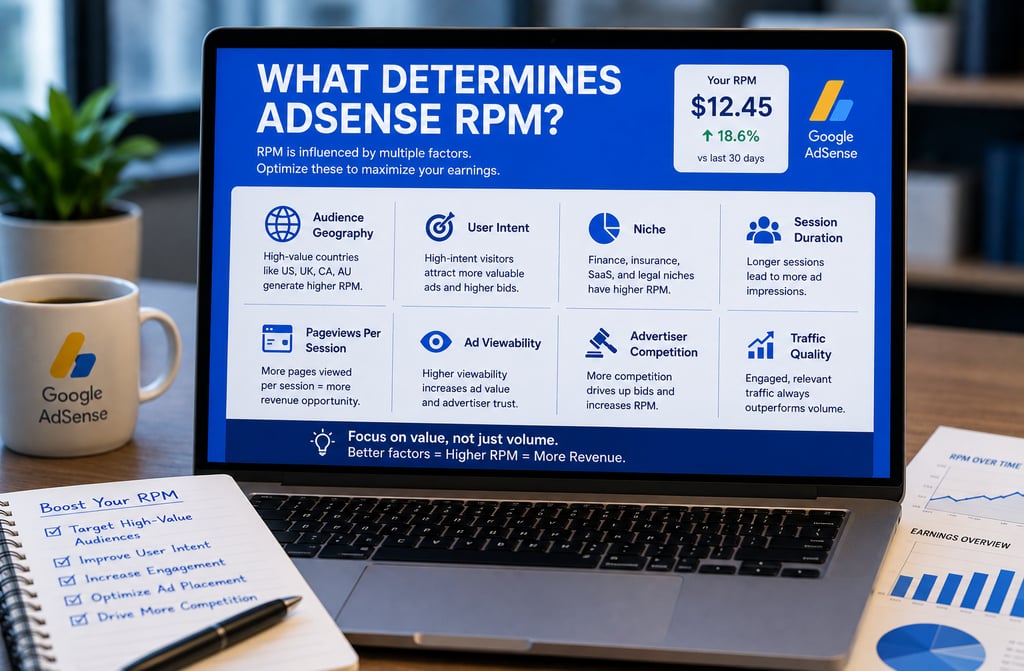
One of the most frustrating experiences for publishers is opening their AdSense dashboard and seeing an RPM that seems far lower than expected.
Maybe your traffic is growing.
Maybe you're publishing more content than ever.
Maybe your site is getting thousands of visitors every day.
Yet your RPM remains stubbornly low.
Naturally, the first question becomes:
"What actually determines AdSense RPM?"
The answer is that RPM is influenced by far more than just traffic.
In fact, many publishers focus on the wrong metrics entirely.
Let's break down the factors that have the biggest impact on AdSense RPM and why two websites with similar traffic can earn dramatically different amounts of money.
First, What Is AdSense RPM?
RPM stands for:
Revenue Per Mille (Revenue Per 1,000 Pageviews)
The formula is:
RPM = (Estimated Earnings/Pageviews)* 1000
In simple terms:
RPM tells you how much revenue you earn for every 1,000 pageviews on your website.
If your RPM is $5, then 100,000 pageviews would generate approximately $500 in revenue.
Because RPM combines multiple performance factors into a single metric, it is often one of the best indicators of monetization health.
Traffic Volume Is Not the Main Driver
This surprises many publishers.
A website with:
50,000 pageviews
can sometimes earn more than a website with:
500,000 pageviews
How?
Because RPM depends on the value of the audience, not just the size of the audience.
Advertisers care about who your users are, not simply how many of them exist.
Audience Geography Has a Huge Impact
One of the biggest RPM drivers is where your visitors come from.
Traffic from countries such as:
United States
Canada
United Kingdom
Australia
typically generates stronger advertiser demand.
Why?
Because advertisers in these markets often have larger budgets and higher customer values.
More advertiser competition generally leads to higher RPM.
This is why two websites in the same niche can earn very different amounts depending on geographic traffic distribution.
User Intent Matters More Than Most Publishers Realize
Consider these two visitors:
Visitor A
Searches:
"Best business bank account for startups"
Visitor B
Searches:
"Funny animal pictures"
The first visitor is much closer to making a purchasing decision.
Advertisers value that user more.
As a result:
bids increase
advertiser competition increases
RPM improves
Intent is often one of the strongest drivers of monetization performance.
Your Niche Influences RPM
Certain industries consistently attract higher advertising budgets.
Examples include:
Higher RPM Niches
Finance
Insurance
SaaS
Legal
Business
Education
Lower RPM Niches
Entertainment
General gaming
Memes
Viral content
This doesn't mean lower-RPM niches cannot succeed.
It simply means advertiser demand differs significantly between industries.
Session Duration Affects RPM
The longer users stay on your website:
the more ads they see
the more pages they visit
the more impressions are generated
This increases the amount of revenue generated per visitor.
Publishers often focus entirely on traffic acquisition while ignoring engagement.
But engagement is one of the most important RPM drivers.
Pageviews Per Session Increase Revenue
If users visit:
one page and leave
your revenue opportunity is limited.
If users visit:
three
four
five pages
the monetization opportunity increases significantly.
More pageviews per session generally means more revenue per visitor.
And more revenue per visitor leads to higher RPM.
Ad Viewability Matters
Advertisers prefer impressions that users actually see.
Ads that are:
highly visible
properly positioned
actively viewed
often attract stronger bidding.
Low viewability can reduce inventory value and suppress RPM.
Advertiser Competition Is Critical
This is one of the most overlooked RPM factors.
Programmatic advertising is based on auctions.
When more advertisers compete for your inventory:
bids rise
CPM increases
RPM improves
When competition is weak:
revenue declines
Many publishers never realize that increasing advertiser competition can have a larger impact than increasing traffic.
Why RPM Changes Every Day
Many publishers panic when RPM fluctuates.
But RPM naturally changes because:
advertiser budgets change
bidding behavior changes
traffic sources change
seasonality changes
This is completely normal.
Daily RPM fluctuations do not necessarily indicate a problem.
Long-term trends matter far more.
The Limitation of Basic AdSense Setups
AdSense works well for many smaller publishers.
But as traffic grows, some publishers discover a limitation:
Their audience value increases faster than their monetization performance.
This often happens because advertiser competition remains limited.
As websites scale, publishers frequently explore solutions that introduce stronger demand competition and more advanced yield optimization.
How AdPlunge Helps Improve RPM
Many growing publishers eventually move beyond a basic AdSense-only setup.
Platforms like AdPlunge help publishers:
access premium demand
increase auction competition
improve inventory value
optimize monetization performance
The goal is simple:
Maximize the revenue generated from every visitor.
Because improving RPM is often easier and faster than doubling traffic.
Final Thoughts
AdSense RPM is influenced by many factors working together.
These include:
audience geography
niche
user intent
session duration
pageviews per session
advertiser competition
ad viewability
This is why two websites with similar traffic can generate dramatically different revenue.
Publishers who understand these factors can focus on improving audience quality and monetization efficiency instead of simply chasing more traffic.
And in many cases, optimizing RPM becomes the fastest path to increasing overall revenue.
Related Articles
Why Your AdSense RPM Is So Low in 2026
Why Your Website Traffic Increased But Revenue Didn't
© 2025. All rights reserved.