
Why Your Ad Revenue Is Inconsistent
Ad revenue rarely stays the same from day to day, which can be frustrating and confusing for publishers. In this article, we explain the most common reasons ad revenue fluctuates, including changes in advertiser demand, traffic quality, audience geography, user engagement, seasonality, and CPMs. Learn why revenue can rise or fall even when traffic remains stable, how to distinguish normal fluctuations from real problems, and what you can do to create more consistent monetization performance over time.
AD-PERFORMANCE ISSUES
Veronica
6/8/20263 min read
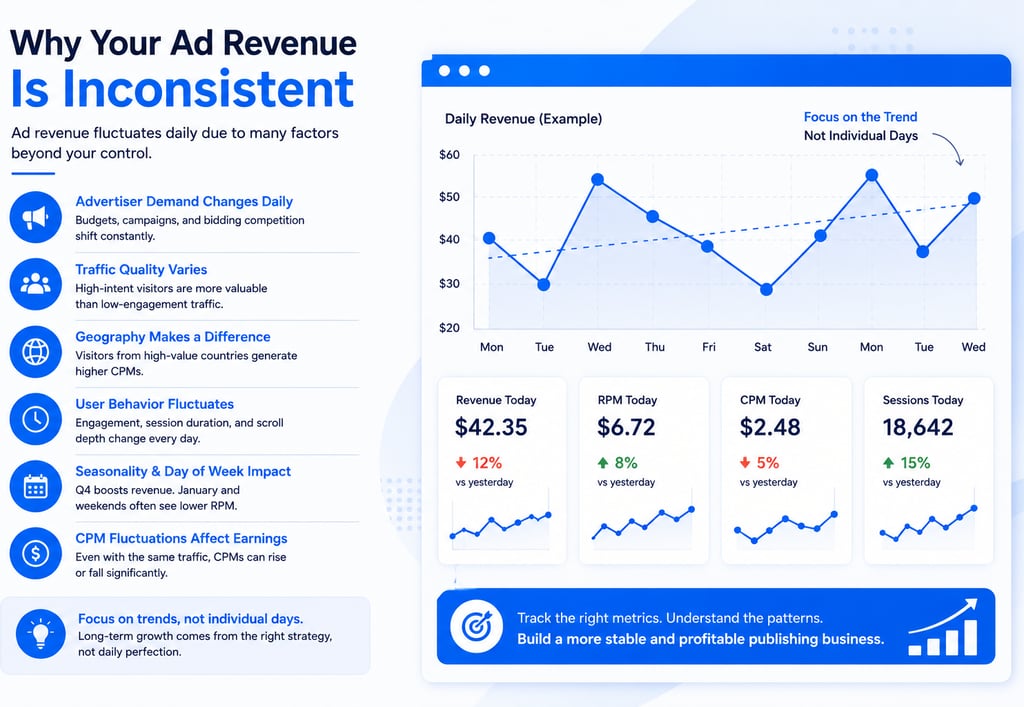
One day your website earns $50.
The next day it earns $35.
A few days later it's back to $55.
Then suddenly it drops again.
If you've ever checked your monetization dashboard and wondered:
"Why is my revenue all over the place?"
You're not alone.
Inconsistent ad revenue is one of the most common concerns among publishers.
And the frustrating part is that many publishers immediately assume something is broken.
In reality, revenue fluctuations are often completely normal.
The key is understanding what causes them.
Because once you understand the factors behind revenue volatility, you can focus on what actually matters instead of worrying about every daily change.
First: Revenue Is Not Supposed to Be Perfectly Stable
Many publishers expect revenue to move in a straight line.
More traffic today should equal more revenue today.
Less traffic should mean less revenue.
Simple, right?
Unfortunately, digital advertising doesn't work that way.
Ad revenue is influenced by dozens of variables that change constantly.
This means fluctuations are a normal part of programmatic advertising.
Advertiser Demand Changes Every Day
One of the biggest drivers of revenue inconsistency is advertiser demand.
Advertisers are constantly:
increasing budgets
reducing budgets
launching campaigns
ending campaigns
changing targeting strategies
As demand shifts, auction competition shifts.
And when competition changes, revenue changes.
Even if your traffic stays exactly the same.
Traffic Quality Changes Constantly
Many publishers focus only on visitor numbers.
But revenue is often influenced more by traffic quality than traffic volume.
For example:
100 visitors from:
high-intent search traffic
can sometimes generate more revenue than:
500 visitors from:
low-engagement social traffic
If your traffic sources vary from day to day, revenue may vary as well.
Audience Geography Fluctuates
Different countries generate different advertising value.
Traffic from countries such as:
United States
Canada
United Kingdom
Australia
often earns significantly higher CPMs.
If your geographic traffic mix changes, revenue can change too.
Even if total pageviews remain stable.
User Behavior Changes Revenue
Revenue depends heavily on engagement.
When users:
stay longer
scroll deeper
visit more pages
more monetization opportunities are created.
But user behavior naturally fluctuates.
Some days users are more engaged.
Some days they are not.
These changes can influence revenue surprisingly quickly.
Seasonality Plays a Huge Role
Advertising budgets follow seasonal patterns.
For example:
Q4 (October–December)
Advertisers spend aggressively.
Competition increases.
Revenue often rises.
January
Budgets reset.
Competition weakens.
Revenue often falls.
This seasonal cycle affects publishers across nearly every niche.
Weekdays and Weekends Behave Differently
Many publishers notice:
stronger weekday RPM
weaker weekend RPM
This is common.
Depending on your audience and niche, advertiser demand may vary significantly throughout the week.
This can create noticeable daily revenue swings.
CPM Fluctuations Affect Revenue
Even if:
pageviews stay constant
impressions stay constant
revenue can still change.
Why?
Because CPMs change constantly.
Factors affecting CPM include:
advertiser demand
audience value
bidding competition
seasonality
Small CPM changes can have large revenue effects.
Revenue Can Drop Even When Traffic Increases
This is one of the most confusing situations publishers encounter.
Traffic grows.
Revenue falls.
How is that possible?
Because traffic growth alone doesn't guarantee revenue growth.
If new visitors:
have lower intent
engage less
come from lower-value regions
RPM may decline.
This can offset traffic gains entirely.
The Difference Between Normal and Problematic Volatility
Not every revenue fluctuation is a problem.
Normal volatility:
small daily changes
gradual seasonal shifts
temporary CPM fluctuations
Potential warning signs:
sustained RPM decline
major traffic-quality changes
viewability issues
engagement collapse
The key is focusing on trends, not individual days.
What Publishers Should Actually Monitor
Instead of obsessing over daily earnings, focus on:
RPM
Is revenue efficiency improving?
CPM
Are advertisers valuing your inventory?
Session Duration
Are users staying longer?
Pageviews Per Session
Are users consuming more content?
Bounce Rate
Are visitors engaging with your site?
These metrics often reveal the real cause of revenue fluctuations.
How to Make Revenue More Consistent
While no publisher can eliminate volatility completely, you can reduce it.
Focus on:
Building Returning Audiences
Returning visitors create more stable traffic patterns.
Improving Engagement
Higher engagement often leads to more predictable monetization.
Diversifying Traffic Sources
Relying on one source increases volatility risk.
Increasing Advertiser Competition
More competition often creates stronger revenue stability.
How AdPlunge Helps Reduce Revenue Volatility
One challenge many publishers face is limited advertiser competition.
When demand is concentrated, revenue becomes more sensitive to market changes.
Platforms like AdPlunge help publishers:
access premium demand sources
increase auction competition
improve RPM consistency
maximize inventory value
Because stronger demand often leads to more stable monetization performance.
Final Thoughts
Inconsistent ad revenue is usually not a sign that something is broken.
It is often the result of:
changing advertiser demand
shifting traffic quality
audience geography
seasonality
engagement fluctuations
The most successful publishers don't focus on daily earnings.
They focus on long-term trends and the underlying metrics that drive monetization.
Because once you understand why revenue changes, you can make better decisions and build a more stable publishing business.
Related Articles
© 2025. All rights reserved.