
How Scroll Depth Affects Monetization
Scroll depth is a powerful but often overlooked metric that can have a direct impact on website revenue. In this article, we explain how the amount of content users consume affects ad impressions, viewability, RPM, and overall monetization performance. Learn why deeper engagement leads to more valuable inventory, what causes users to stop scrolling, and how publishers can improve scroll depth to increase ad revenue without needing more traffic.
GENERAL MONETIZATION
Veronica
6/3/20263 min read
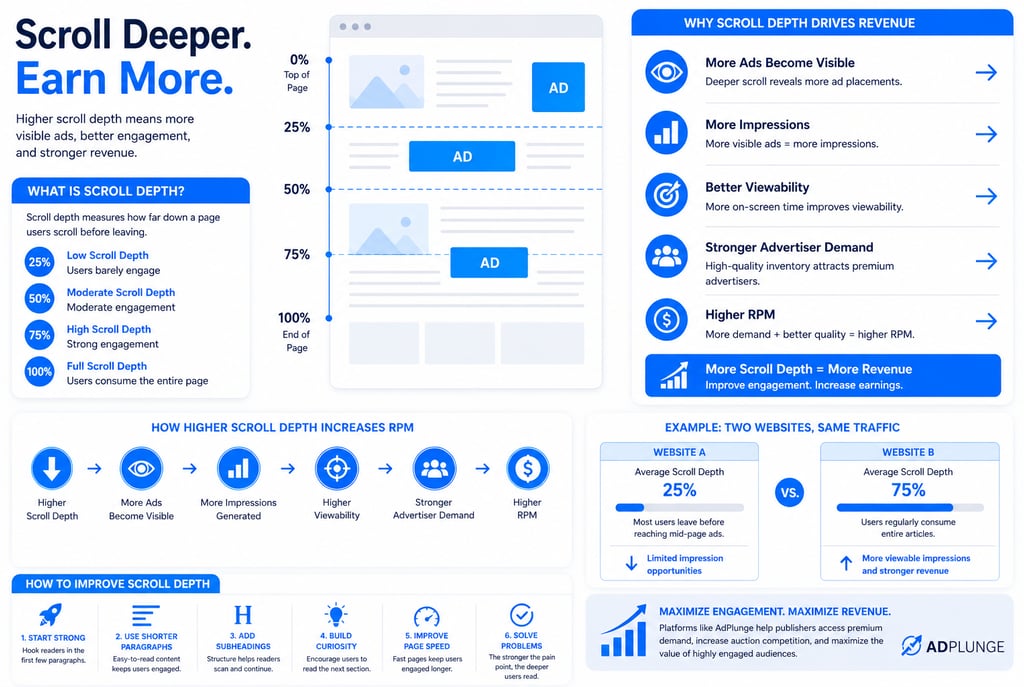
A visitor lands on your website.
They start reading.
They spend a few seconds on the page.
Then they leave.
At first glance, this seems fine.
After all, you still got the pageview.
But here's the problem:
If users aren't scrolling, they're not seeing most of your ads.
And if they're not seeing your ads, advertisers aren't getting value from your inventory.
This is why scroll depth has become one of the most important — and most overlooked — monetization metrics for publishers.
In many cases, improving scroll depth can increase revenue without adding a single new visitor.
What Is Scroll Depth?
Scroll depth measures:
How far down a page users scroll before leaving.
For example:
25% scroll depth = users barely engage
50% scroll depth = moderate engagement
75%+ scroll depth = strong engagement
100% scroll depth = users consume the entire page
The deeper users scroll, the more content they consume.
And the more content they consume, the more ad inventory becomes visible.
Why Scroll Depth Matters for Revenue
Most websites place ads throughout their content.
Some ads appear:
near the top
within content
further down the page
If visitors only scroll a short distance:
lower placements never become visible
impressions are lost
monetization opportunities disappear
In other words:
Unseen ads cannot generate revenue.
The Hidden Revenue Leak
Many publishers focus heavily on:
traffic growth
SEO rankings
content production
But they rarely ask:
"How much of my content are users actually seeing?"
A page may generate thousands of visits.
But if most visitors only scroll 20% down the page, a large portion of potential inventory remains untouched.
Scroll Depth and Ad Viewability
These two metrics are closely connected.
Higher scroll depth often leads to:
better ad viewability
more visible impressions
increased advertiser confidence
And as we've already discussed:
Better viewability often leads to stronger CPMs.
This means scroll depth can influence both:
the number of impressions
the value of those impressions
Example: Two Similar Websites
Imagine two websites.
Both receive:
100,000 monthly visitors
Website A
Average scroll depth:
25%
Most users leave before reaching mid-page ads.
Result:
Limited impression opportunities
Website B
Average scroll depth:
75%
Users regularly consume entire articles.
Result:
More viewable impressions and stronger monetization performance
Same traffic.
Very different revenue outcomes.
Why Users Stop Scrolling
Poor scroll depth usually isn't caused by bad traffic.
It's usually caused by poor user experience.
Common causes include:
Weak introductions
Users don't find value quickly enough.
Poor formatting
Large blocks of text discourage reading.
Slow page speed
Users leave before engaging.
Low-quality content
Visitors don't feel compelled to continue.
Lack of curiosity
The content doesn't create a reason to keep scrolling.
How Better Scroll Depth Increases RPM
Here's the chain reaction:
Higher scroll depth → More ads become visible → More impressions generated → Higher viewability → Stronger advertiser demand → Higher RPM
This is one reason publishers can increase revenue without increasing traffic.
They're simply extracting more value from existing visitors.
How to Improve Scroll Depth
1. Start Strong
The first few paragraphs determine whether users continue reading.
Give readers a reason to stay.
2. Use Shorter Paragraphs
Large walls of text increase abandonment.
Easy-to-scan content improves engagement.
3. Add Subheadings
Readers naturally continue when content feels structured and easy to follow.
4. Build Curiosity
Each section should encourage users to continue to the next one.
5. Improve Page Speed
Slow pages kill engagement before scrolling even begins.
6. Focus on Solving Problems
The stronger the pain point, the deeper users tend to read.
Why Scroll Depth Matters More Than Publishers Realize
Most publishers think:
"I need more traffic."
But often the faster win is:
"I need my existing visitors to consume more content."
Because monetization improves when users engage more deeply.
Higher scroll depth improves:
viewability
engagement
impression volume
RPM potential
All without increasing acquisition costs.
The Connection to Premium Monetization
As engagement improves, the quality of your inventory improves.
Premium advertisers prefer:
engaged audiences
viewable inventory
longer sessions
This means higher scroll depth can increase the attractiveness of your inventory across ad auctions.
How AdPlunge Helps Maximize High-Engagement Inventory
Increasing scroll depth is only part of the equation.
You also need advertisers competing aggressively for those impressions.
Platforms like AdPlunge help publishers:
access premium demand
increase auction competition
maximize the value of highly engaged audiences
improve RPM across viewable inventory
Because when users consume more content, every impression becomes more valuable.
Final Thoughts
Scroll depth is one of the clearest indicators of content engagement.
The deeper users scroll:
the more ads they see
the more impressions are generated
the more valuable your inventory becomes
Many publishers focus entirely on traffic growth.
But sometimes the biggest revenue gains come from improving how existing visitors interact with your content.
And improving scroll depth is one of the most effective ways to do exactly that.
Related Articles
How Session Duration Affects RPM
How Bounce Rate Impacts Ad Revenue
How Pageviews Per Session Increase Revenue
© 2025. All rights reserved.